Updated 7:59 p.m. April 7.
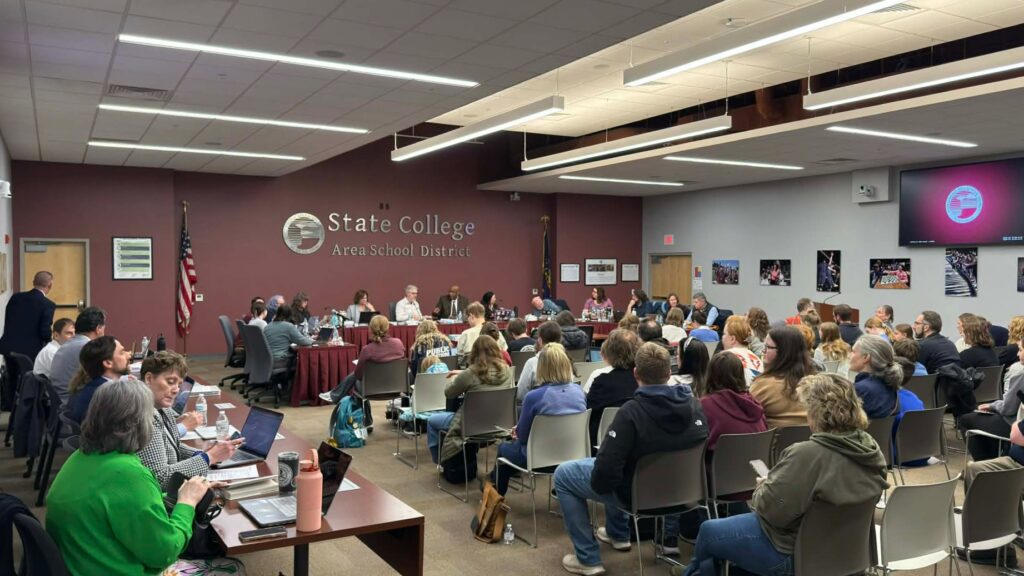
Nearly 20 students and parents spoke at Monday night’s State College Area School Board meeting to urge the district to provide equitable music education at the Delta Middle School.
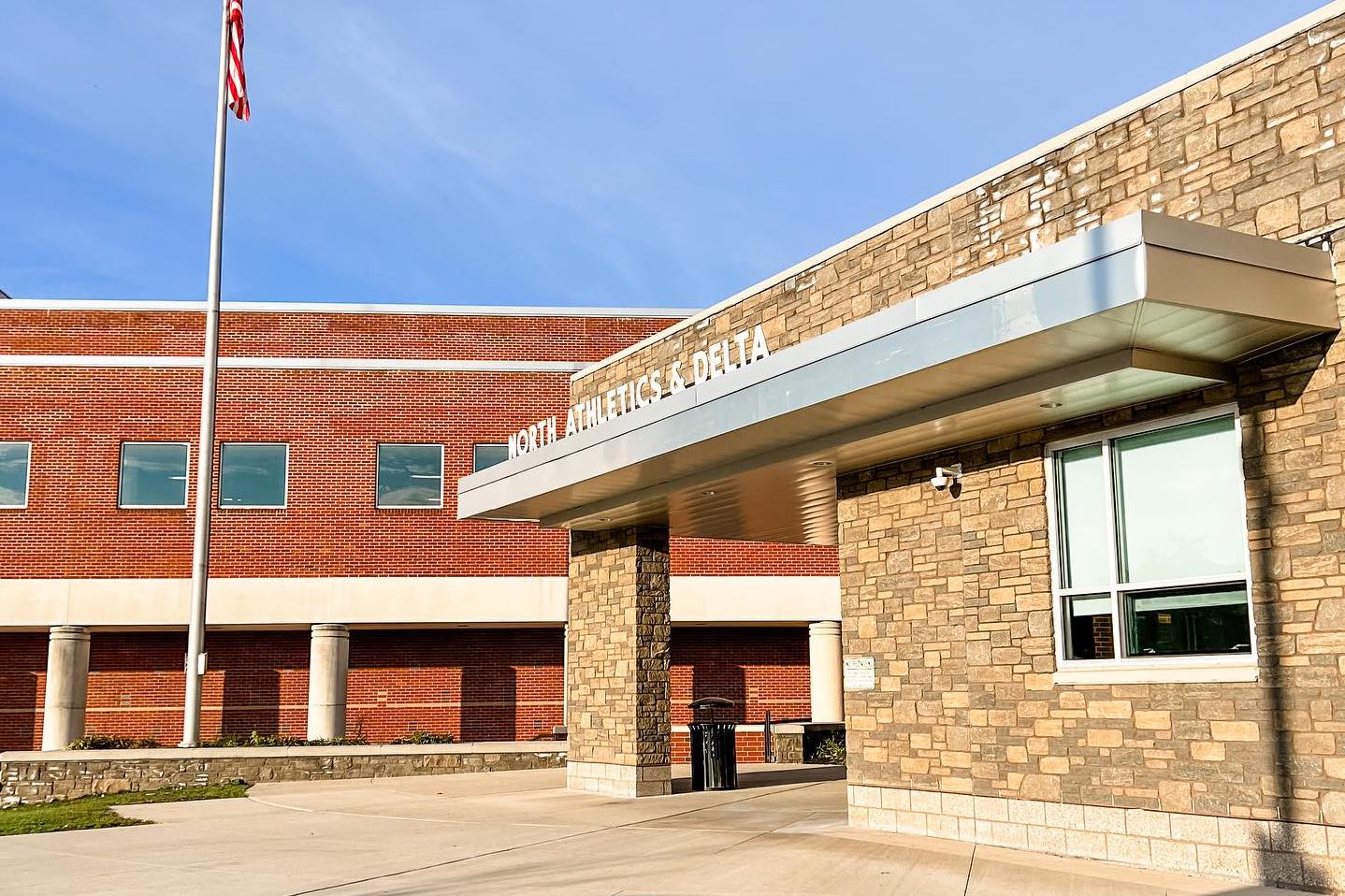
While Delta Middle, which along with Delta High transitioned from an alternative program to a formally recognized school this academic year, has a music teacher, students are not offered instrumental music instruction as part of the curriculum, unlike their peers at Mount Nittany and Park Forest middle schools.
Those who spoke on Monday asked the board to consider either hiring a part-time instrumental music teacher or, recognizing financial constraints, implement a “budget-neutral” option of allocating some of an existing middle school instructor’s time to Delta, a democratically-operated, community-oriented option that allows students and faculty to collaborate on curriculum and program-wide decisions.
“When families enrolled at Delta, they were told students would have access to co-curricular opportunities across the district, which has not been supported,” parent Eve Bellinger said. “… At Park Forest and Mount Nittany Middle, students have access to instrumental music teachers, in-school lessons and full ensemble experiences. At Delta, we do not have those opportunities. This is not equitable access; it is a barrier.”
SCASD spokesperson Nabil Mark said on Tuesday that the district has, not to date, had discussions about adding instrumental instruction at Delta Middle.
Delta Middle, with a student enrollment of about 140, is designed to be an alternative educational experience to Mount Nittany and Park Forest, which each have enrollments of about 800. The comparison, Mark said, is “not apples-to-apples” and Delta offers a variety of opportunities not available at the other middle schools, and vice versa.
“It’s certainly not intended to be exclusionary,” he said.
Instrumental music was not offered when Delta was a program, and most parents who spoke on Monday said they understood at the time that they had to make the trade-off for their children to have the right academic fit.
But they noted that in 2024, when the board approved making Delta a middle school and high school, it adopted a resolution “affirming the fundamental tenets of Delta.” It included that the board “affirms the option to participate in extracurricular and co-curricular activities at either State High or the appropriate middle school catchment area will continue to be available to Delta students.”
Parent Julie Coder said Delta Middle students can participate in intramural sports at their home middle school, but do not have the same opportunity for instrumental music.
“By not offering instrumental music to our Delta students, we could potentially be cutting off those opportunities for them at the high school and college level,” Coder said.
Some students have pursued private instruction, but parent Mark Ferraguto said a violin ensemble formed for Delta students at a local music academy is $250 per semester, while a year of 30-minute private lessons is $1700.
That, in turn, also leads to inequitable outcomes, said parent Ariana Mikulski.
“The district has created a situation in which those with money can attend Delta and attempt to compensate for the lack of instrumental music instruction, while those without the financial means are forced into difficult choices,” Mikulski said. “How does the district justify a decision that imposes barriers to participation for lower income students? If the district truly cares about equity and wants to ensure that every student has opportunities to grow, thrive, and fulfill their potential. Through caring responsive education, the board will address this disparity.”
A survey of incoming sixth-grade families and current sixth and seventh-grade families found 114 Delta Middle students are interested in receiving instrumental instruction, parent Ross Bellinger said. Of those, 62 are currently receiving private instruction.
Several parents and students said private instruction is not the same experience as in-school ensembles.
“It is disappointing and frustrating that there is not instrumental music and I miss getting to play with an ensemble,” sixth-grade student Will Coder said. “Practicing at home by myself is not the same, and I probably will not have the motivation to do it. This hasn’t been resolved, And the result of this is kids not getting the continued lessons that they may have received in elementary school. I am very concerned that when the time comes for high school, I will be too far behind my peers at Mount Nittany Middle and Park Forest Middle School.”
Fellow sixth-grade student Amy McCormick said an in-school ensemble provides other benefits, as well.
“Among many things, an orchestra or band is helpful for students’ social learning and growth,” she said. “They encourage students to interact with other students and learn how to play their instrument with a group instead of just one-on-one. A music program also helps students to have great opportunities through high school. There are many music programs and extracurricular opportunities in high school, And many Delta Middle School students will not be at the same skill level as the students from Mount Nittany and Park Forest Middle Schools, and therefore will not have as good of a chance to be able to participate in those activities.”
Julie Coder said she has previously been told by board members that Delta’s smaller class sizes play a role in the lack of instrumentals instruction.
But based on information provided to her by the district, Mount Nittany has a student-teacher ratio of 10.3 to 1, Park Forest 12.2 to 1 and Delta 11.8 to 1.
Eve Bellinger, meanwhile, pointed out that Mount Nittany and Park Forest have a combined 13 concerts this academic year. While students and parents would prefer a dedicated part-time instructor, she said that indicates the district might be able to allocate some existing resources to Delta Middle.
“That is a lot of concerts. That is a lot of time. That is a lot of music instruction,” she said. “So whether that means distribution of a teacher coming to Delta Middle or whether that means maybe one less thing is offered at Park Forest or Mount Nittany to make that redistribution look better, I think that’s something for the board to consider as we’re looking for budget-neutral options within the district.”
The district takes pride in the music education it offers, which parent Andrew Mitchell said makes the lack of instrumentals at Delta all the more frustrating.
“I think it’s mind-boggling that SCASD is not providing opportunities for Delta students to participate in instrumental education, and I find it even more mind-boggling that we’re looking to private groups to fill that gap,” he said.
Board members did not address the issue during public comment, though some made references to it during a later budget discussion.
“I personally absolutely love music, and you’ve sold me that we need a new music teacher for Delta,” board member Jennifer Black said.
Black said, though, that she recognized budget constraints and asked if there is “a way to accomplish something like that creatively without spending too much more money.”
“We’d have to work with our instructional leaders,” Randy Brown, finance and operations officer, said.
Speaking generally, Superintendent Curtis Johnson said the district has “a finite budget,” and that this year it received requests for the addition of 26 positions across 12 schools. The district’s proposed 2026-27 budget includes five new positions: a part-time science teacher for an additional middle school class, two custodians to cover the additional square footage added by Mount Nittany Elementary expansion, and co-ed hockey and co-ed rugby club coaches.
Johnson also said the district expects it will need to hire additional special education staff to meet growing enrollment and state and federal mandates, among other rising expenses.
“Obviously, we cannot fund 26 positions,” Johnson said. “As you can see right now, we’re saying that we can only do certain very minimal [additions] to stay within the revenues that we have.”
Black said she didn’t mean to suggest other requested positions should be diminished in favor of a part-time music instructor.
“I just think sometimes it’s important to let everyone know that we can think about this creatively, and we can find creative solutions,” she said. “I don’t want anyone to ever feel like their voice is not being heard because we don’t get exactly what we are hoping to get.”